

How long does it take to charge the battery of a three - door electric tricycle fully?
The time required to fully charge the battery of a three - door electric tricycle can vary significantly based on multiple factors. As a supplier of Three Door Electric Tricycles, I've had extensive experience and knowledge about these vehicles, and I'm here to share some insights on this topic.
Battery Capacity
One of the most crucial factors influencing charging time is the battery capacity. Generally, batteries are measured in ampere - hours (Ah). A larger capacity battery stores more energy but also takes longer to charge. For instance, a three - door electric tricycle with a 20Ah battery will take less time to charge compared to one with a 40Ah battery, assuming all other factors are equal.
Let's say we have a standard charger with a charging current of 2A. Using the simple formula (t=\frac{C}{I}) (where (t) is the charging time, (C) is the battery capacity, and (I) is the charging current), a 20Ah battery would take approximately (t = \frac{20}{2}=10) hours to charge fully. In contrast, a 40Ah battery would need around (\frac{40}{2} = 20) hours. However, in real - world scenarios, this calculation is an oversimplification as there are other factors at play.
Charger Output
The charger's output power is another vital factor. Chargers come with different power ratings, typically measured in watts (W). A high - power charger can deliver more current to the battery, thus reducing the charging time. For example, a charger with an output of 100W might charge the battery faster than a 50W charger.
Modern three - door electric tricycles often come with chargers that are specifically designed for their battery systems. Some advanced chargers use smart charging technology. These chargers can adjust the charging current according to the battery's state of charge. In the initial stage, they can provide a high current to quickly charge the battery to a certain level. As the battery approaches full charge, the charger reduces the current to prevent overcharging, which can damage the battery.
Battery Type
There are different types of batteries used in three - door electric tricycles, such as lead - acid batteries and lithium - ion batteries. Each type has its own charging characteristics.
Lead - acid batteries are commonly used due to their relatively low cost. However, they have a slower charging rate compared to lithium - ion batteries. Lead - acid batteries usually require a longer charging time, often around 8 - 12 hours for a full charge, depending on their capacity and the charger used. They also need to be charged carefully to avoid overcharging, which can cause the battery to lose water and reduce its lifespan.
Lithium - ion batteries, on the other hand, have a higher energy density and can charge more quickly. They can often be charged to 80% of their capacity in a relatively short time, sometimes within 1 - 2 hours. However, charging them to 100% might take a bit longer as the charger needs to switch to a lower - current mode to ensure safety and battery longevity.
State of Discharge
The state of discharge of the battery when charging starts also affects the charging time. If the battery is only slightly discharged, it will take less time to charge compared to a completely discharged battery. For example, if a battery is only 20% discharged, it might take only a couple of hours to reach full charge, while a fully discharged battery could take the full estimated charging time.
Moreover, deep - cycling a battery (completely discharging it before recharging) too often can reduce the battery's lifespan. It is recommended to recharge the battery when it reaches around 20 - 30% of its capacity to maintain its health and performance.
Environmental Conditions
Environmental temperature can have a significant impact on the charging process. Batteries charge more efficiently within a certain temperature range. In cold temperatures, the chemical reactions inside the battery slow down, which can increase the charging time. On the other hand, extremely high temperatures can also be detrimental to the battery and may require the charger to reduce the charging current for safety reasons.
Most batteries perform optimally at temperatures between 20 - 30 degrees Celsius. If the ambient temperature is outside this range, the charging time can be extended, and the battery's overall performance may be affected.
Our Product Range
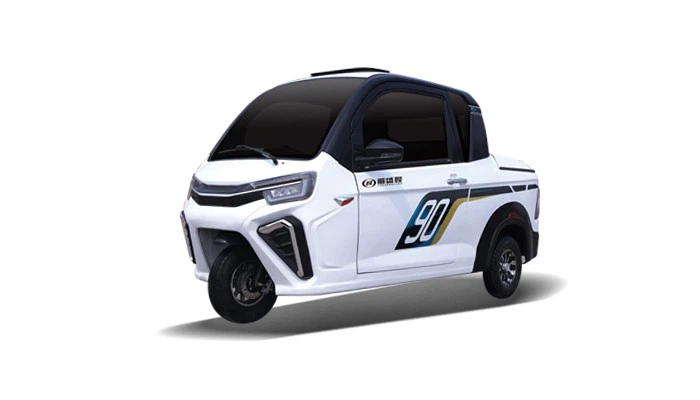
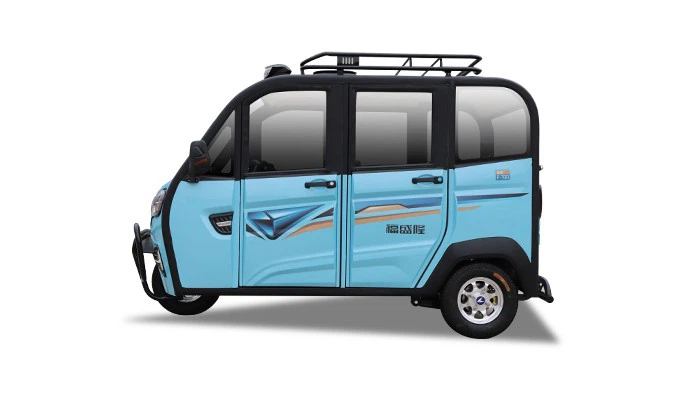
As a supplier of Three Door Electric Tricycles, we offer a diverse range of products to meet different customer needs. Our Pickup Electric Tricycle is designed for those who need to transport goods. It comes with a powerful battery and a suitable charger to ensure efficient operation. The charging time of this model depends on the battery capacity and charger output as described above.
Our Light Electric Cargo Tricycle is a more lightweight option, perfect for short - distance deliveries. It is equipped with a battery that can be charged relatively quickly, making it a convenient choice for daily use.
We also have the Electric Pickup Truck Tricycle, which combines the features of a pickup and an electric tricycle. This model offers a larger cargo capacity and a robust battery system. The charging time of this vehicle is optimized to balance between quick recharging and long - term battery health.
Conclusion
In conclusion, the time it takes to fully charge the battery of a three - door electric tricycle is influenced by multiple factors, including battery capacity, charger output, battery type, state of discharge, and environmental conditions. On average, it can range from a few hours to over 20 hours.
If you are interested in our Three Door Electric Tricycles or have any questions about charging times, battery performance, or our product range, we welcome you to contact us for further discussion and potential procurement. We are committed to providing high - quality products and excellent customer service.
References
- Battery Technology Handbook, various editions
- Electric Vehicle Engineering textbooks
- Industry reports on electric tricycle battery performance