

What is the braking distance of a freight four - wheeled vehicle at different speeds?
As a supplier of freight four - wheeled vehicles, one of the most frequently asked questions I encounter is about the braking distance at different speeds. Understanding the braking distance of these vehicles is crucial not only for drivers' safety but also for logistics planning and regulatory compliance.
Factors Affecting Braking Distance
The braking distance of a freight four - wheeled vehicle is influenced by multiple factors. First and foremost is the speed of the vehicle. The higher the speed, the longer the braking distance. This is due to the fact that kinetic energy is proportional to the square of the velocity. According to the kinetic energy formula (KE=\frac{1}{2}mv^{2}), where (m) is the mass of the vehicle and (v) is the velocity, as the speed doubles, the kinetic energy quadruples. Therefore, more energy needs to be dissipated during braking, which requires a longer distance.
Another important factor is the mass of the vehicle. Freight four - wheeled vehicles are often loaded with various goods, and the heavier the load, the longer the braking distance. A fully - loaded vehicle has more inertia, making it harder to stop quickly. The braking system also plays a vital role. Well - maintained brakes with high - quality brake pads and rotors can significantly reduce the braking distance. Tires are also a key factor. Tires with good traction can grip the road better, allowing for shorter braking distances. Road conditions, such as wet, icy, or uneven roads, can increase the braking distance as well.
Braking Distance at Different Speeds
Let's explore the approximate braking distances at different speeds for a typical freight four - wheeled vehicle. At a low speed of 20 km/h, the braking distance is relatively short, usually around 3 - 5 meters. This is because the kinetic energy is relatively small at this speed, and the brakes can quickly dissipate the energy.
When the speed increases to 40 km/h, the braking distance extends to about 10 - 15 meters. As mentioned earlier, the kinetic energy has quadrupled compared to the 20 km/h speed, so the brakes need more time and distance to stop the vehicle.
At 60 km/h, the braking distance can be around 25 - 35 meters. This significant increase in braking distance highlights the importance of maintaining a safe following distance at higher speeds. A small miscalculation in speed or reaction time can lead to a serious accident.

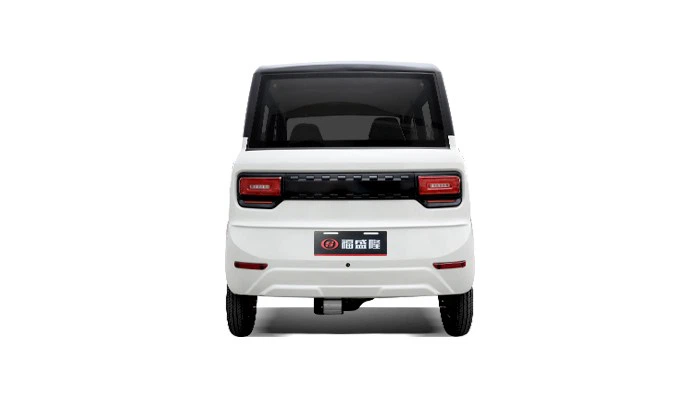
When the vehicle is traveling at 80 km/h, the braking distance may reach 45 - 60 meters. At this speed, the vehicle has a large amount of kinetic energy, and the braking system must work hard to bring the vehicle to a stop.
For speeds of 100 km/h or more, the braking distance can be over 80 meters. This shows that driving at high speeds in a freight four - wheeled vehicle is extremely dangerous, especially when considering the additional factors such as road conditions and reaction time.
Importance of Understanding Braking Distance for Our Products
As a supplier of freight four - wheeled vehicles, we understand the significance of providing our customers with vehicles that have optimal braking performance. Our Four Door Electric Pickup Truck is equipped with advanced braking systems that are designed to reduce the braking distance as much as possible. These systems are regularly tested and updated to ensure they meet the highest safety standards.
Our Passenger and Freight Four Wheeled Vehicles are also engineered with safety in mind. We use high - quality brake components and design the vehicles to have a balanced weight distribution, which helps to improve the braking efficiency.
The Frame Electric Cargo Four - Wheeler is another product in our lineup. It is built with a robust frame and a reliable braking system to handle the heavy loads typically carried by freight vehicles. By understanding the braking distances at different speeds, we can better design and improve our products to meet the needs of our customers.
Calculating Braking Distance
The braking distance can be calculated using the following formula: (d=\frac{v^{2}}{2\mu g}), where (d) is the braking distance, (v) is the initial velocity, (\mu) is the coefficient of friction between the tires and the road surface, and (g) is the acceleration due to gravity ((g = 9.8m/s^{2})).
However, it is important to note that this is a simplified formula, and in real - world situations, other factors such as the efficiency of the braking system, the reaction time of the driver, and the condition of the vehicle also need to be considered.
Safety Recommendations for Customers
To ensure the safety of our customers, we recommend the following:
- Regular Maintenance: Have the braking system checked regularly. This includes inspecting the brake pads, rotors, and brake fluid levels. Worn - out brake pads should be replaced immediately to maintain optimal braking performance.
- Safe Driving Speeds: Adhere to the speed limits and adjust the speed according to the road conditions. Driving at a moderate speed can significantly reduce the risk of accidents and shorten the braking distance.
- Maintain a Safe Following Distance: Keep a sufficient distance from the vehicle in front. A general rule of thumb is to maintain at least a 3 - second following distance at normal speeds. This gives the driver enough time to react and brake in case of an emergency.
Conclusion
In conclusion, the braking distance of a freight four - wheeled vehicle is a complex topic that is affected by multiple factors, especially speed. As a supplier, we are committed to providing our customers with vehicles that have excellent braking performance. Our Four Door Electric Pickup Truck, Passenger and Freight Four Wheeled Vehicles, and Frame Electric Cargo Four - Wheeler are all designed with safety in mind.
If you are in the market for high - quality freight four - wheeled vehicles, we invite you to contact us for procurement discussions. We are ready to provide you with detailed product information and customized solutions to meet your specific needs.
References
- Smith, J. (2020). Vehicle Dynamics and Safety. Academic Press.
- Brown, A. (2019). Handbook of Road Vehicle Design. Elsevier.